Watch my review
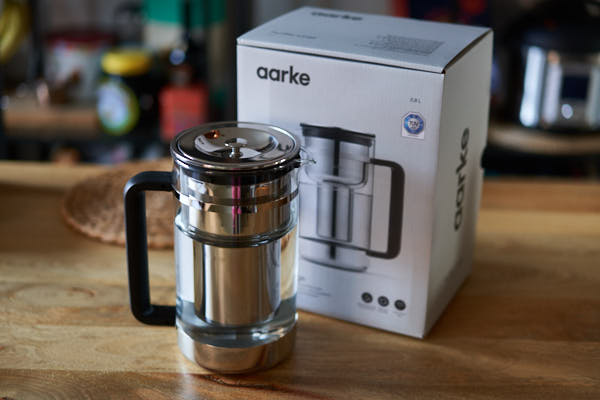
Aarke’s small water purifier (affiliate link) is similar to the larger one, which I’ve previously reviewed on this blog. Since I wrote that review, I’ve learnt more about the granules that Aarke uses, largely thanks to the commenters on my YouTube review.
Pros
Taste
Aarke makes two types of granules. I mostly use the Pure pack as it’s designed to reduce limescale and I have really hard water. These granules significantly change the taste of our water, giving it a clean, sharp, bright taste that’s similar to Brita filtered water.
Aarke’s Enriched granules add magnesium* and alkalise the water but they aren’t designed to remove limescale. Col and I find that they don’t change the taste of the water all that much.
A commenter asked if the water takes on a metallic taste after sitting in the stainless steel cartridge. To me, it doesn’t, but another commenter’s husband disagrees. The change in taste is always strongest with fresh granules. Then it subsides as more water filters through the purifier. Filtering takes 3-5 minutes for 1 litre according to Aarke. I haven’t timed it but it’s fairly fast.
Softens water
My video review shows the difference between using Aarke’s Pure filtered water vs Phox’s Alkaline filtered water in my kettle. In Phox’s defence, the alkaline pack isn’t designed to remove limescale. They recommend their Clean or Softener pack instead.
Aarke’s Pure granules noticeably slow the build-up of limescale in our appliances. After a month or so, I see some limescale but not loads. If I were to use unfiltered tap water, the bottom of the kettle would be coated within a few days.
I haven’t tried Aarke’s Enriched filtered water in my kettle as those granules aren’t designed to reduce limescale.
Good size for a small household
- Height: 27.5 cm
- Diameter: 12 cm
- Filter capacity: 1.18 L / 5 cups
- Total volume: 2.36 L / 10 cups
The small purifier is a good size for smaller households. It depends on how much you’ll use it though. I’m in a household of two and we prefer the larger size. Aarke recommends that you store the purifier in the fridge “for best quality of water”. It’s got a round footprint, though, so it’s unlikely to fit into a fridge door and it certainly won’t fit onto any of our shelves.
Less plastic waste
It’s great to not throw away a plastic cartridge every month. But the granules go into the bin and they contain plastic. They can’t be recycled unfortunately.
Glass jug is replaceable
I wouldn’t have bought either purifier if the jug wasn’t replaceable. Both are expensive so it’s reassuring to know that if I damage it, a replacement jug will cost £24, for small or large. The price hasn’t increased since I wrote my large purifier review back in October 2024.
Beautiful design
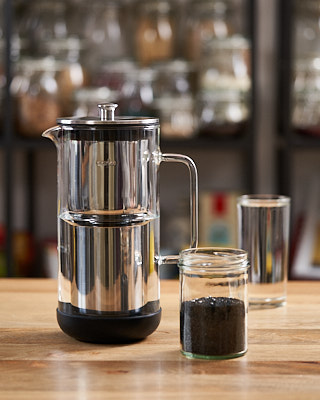
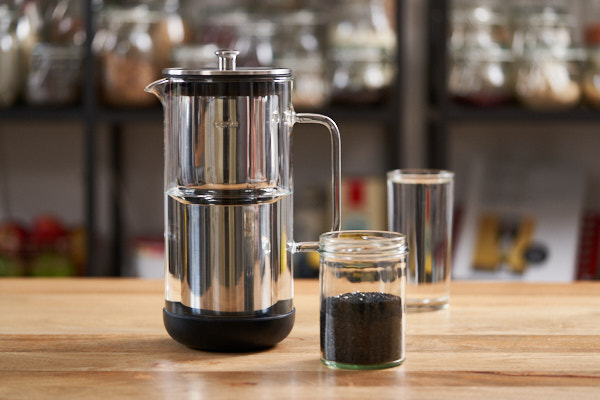
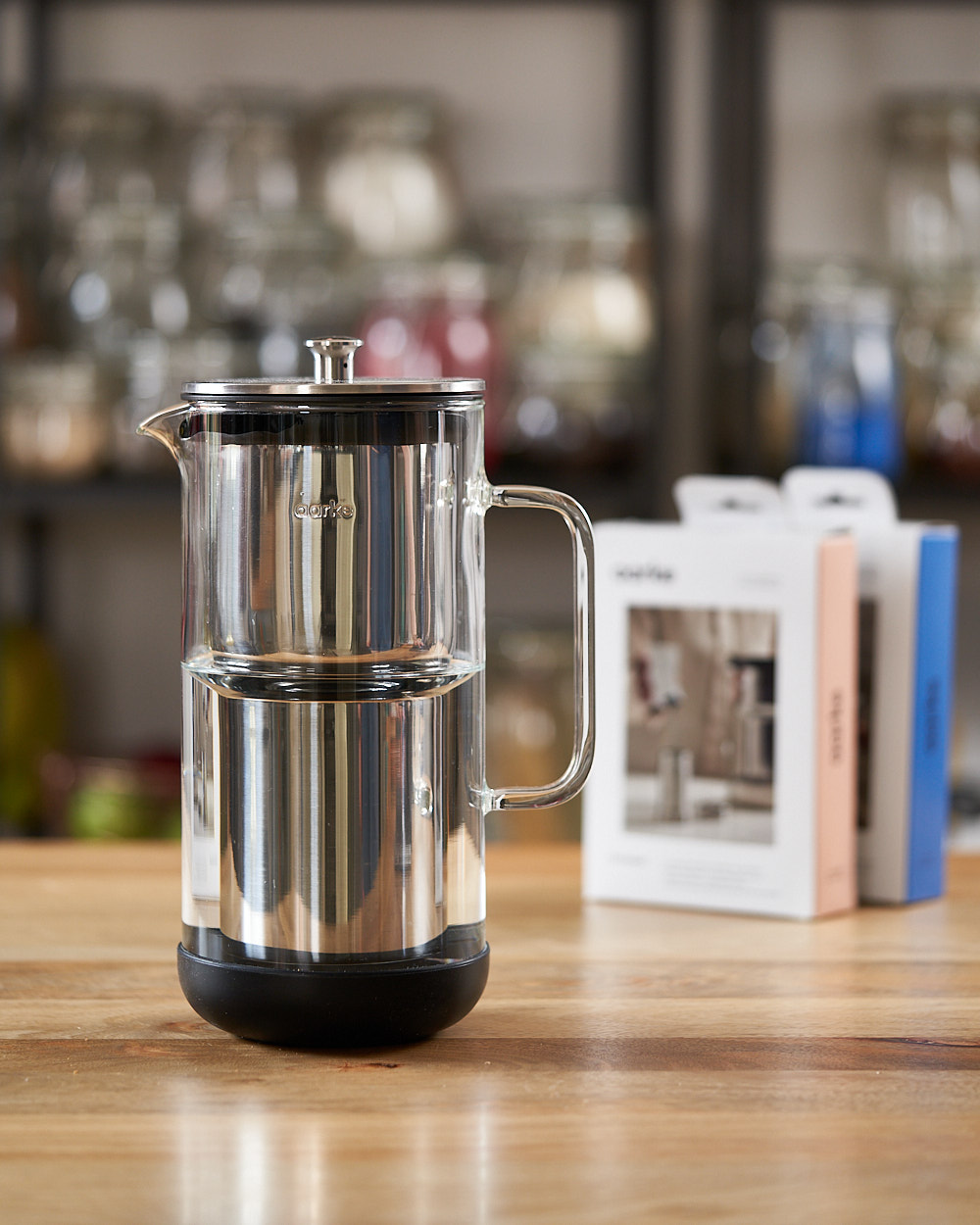
It’s a beautiful water filter with a clean, minimalist design. I prefer the look of the small one over the large. The handle is glass and part of the jug, but I understand why the larger one has a plastic handle, as it’s heavy when full. I prefer the small lid too but there isn’t much in it.
Maintenance is fairly easy (if you ignore the instructions)
All the parts are dishwasher safe at 60°C/140°F. I don’t put the parts into my dishwasher because I don’t want the glass to go cloudy and it’s easy to clean by hand. After about 18 months of using the large purifier, I had to soak the hopper upside down in white vinegar to remove built-up limescale. If you don’t have hard water, this shouldn’t be an issue.
The instructions advise that once a week:
- The filter cartridge should be placed in boiling water for 3 minutes (with the granules in it)
- Allow to cool then place back into the purifier
- Fill and discard the water then proceed as usual
I’ve never done this.
Fill the cartridge with anything (within reason)
Unsurprisingly, Aarke says that you must use Aarke granules in an Aarke filter. To me, it’s a pro that you can fill the cartridge with anything, and that’s how I was able to test Phox’s granules (although multiple Phox packs were needed for one cartridge).
Aarke conveniently gives you the right amount of granules, but recent packs have been short by at least 3 mm. I’m not sure if that makes a difference to the water but I do feel slightly cheated when that happens.
Cons
Price
It’s not cheap but I have no doubt that it will last - both the small and large purifiers feel really premium (they cost £100 and £120 respectively). I’ve owned the large purifier for over 18 months and it’s still in great condition. I paid less for both because I used a 10 or 20% off voucher at Lakeland**.
Aarke’s purifier is the only countertop filter I could find that’s made almost entirely from glass and stainless steel, which goes some way to justifying the price in my mind.
Filter change is more fiddly than a Brita
When changing a Brita cartridge, you remove the old one, then soak and insert a new one. With Aarke, you need to remove the granules, which do get stuck in the cartridge. A spoon can help to dislodge them but a commenter pointed out this will damage the plastic and create plastic micro-dust. I disagree; I’m only getting the granules out with a spoon, then I wash everything and pour the new granules in.
One reviewer on the John Lewis website said that the granules escape into the water.
“But even worse is that those little micro-beads which make up the filter escape all the time. I can't get them completely out of our kettle and I am constantly seeing them at the bottom of my glass and cups of tea.”
As long as you dry the parts carefully, this should never happen. Granules can’t escape out of the top or bottom of the cartridge, thanks to the fine mesh. However, if the cartridge is wet when you refill it, the granules can stick to the thread, stopping the lid from closing properly and that’s when granules can escape. You can easily avoid this by making sure that the cartridge is bone dry before refilling. I’ve never seen granules in my tea or water.
No flip cap
With my old Brita filter, I would flip the lid open and shove the jug under a tap. With Aarke, the entire lid needs to be removed and sometimes it refuses to budge. Col thought that if we immediately put the lid on after filling the hopper, the water draining out the bottom might create a vacuum. Claude AI was having none of that logic and said it’s more likely that the silicone grips really well onto a wet surface. I don’t know but it’s frustrating when it happens. Sometimes the hopper comes out with the lid too. If you’ve got any kind of mobility or strength issues with your hands, you may find the lid tricky. Mostly it's fine and pulling it straight up helps.
The instructions advise placing the lid handle side down, for hygiene reasons. The handle gets scuffed but that doesn’t bother me. Put it on a tea towel or something soft if the scuffs will annoy you.
Heavy when full
It’s not as heavy as the large filter, but when there’s water in both the hopper and the jug, it’s fairly heavy. It weighs nearly 3.5 kilos/7.7 lbs when full.
Hard water? Wipe the spout
Because we have hard water, every single time I use the filter, I wipe the spout. If I didn’t, limescale would build up and the spout would dribble. It’s unavoidable with these kinds of spouts. Initially I soaked the jug upside down in vinegar, but eventually decided that wiping is easier and it quickly became a reflexive habit.
The spout pours nicely (although nothing can top Dualit’s patented Pure Pour™ spout for sheer pouring pleasure). If you don’t have hard water, wiping won’t be necessary.
Boil the cartridge weekly (I don’t)
I mentioned earlier that Aarke advises boiling the cartridge once a week. Brita filters don’t have the same requirement. If you’re concerned about hygiene, this could be a pro. The cartridge is made from stainless steel so you can boil it, unlike a plastic Brita. It’s up to you but I don’t bother.
A note on the granules, which contain plastic
When I bought my large filter, I thought that my water would have minimal contact with plastic. I was wrong. Both Aarke granules contain ion-exchange resin beads, which are made from plastic. It’s the same for Brita, and for two out of Phox’s three granules.
Why do companies use ion-exchange resin? In short, because it softens water. I made a video where I tested Phox’s activated carbon granules in my Aarke filter: zero plastic, but a no-go for me. Activated carbon can’t remove limescale and I may as well have just used tap water. If you don’t have hard water, activated carbon might work for you.
We’re trying to be mindful about plastic but we decided to keep using the large Aarke filter for our coffee machine and kettle because they’re expensive appliances. We sometimes use the smaller Aarke for drinking water but we drink tap water too.
Based on the YouTube comments that I’ve received, I want to point out that this is a countertop water filter. It can only do so much. It can’t remove microplastics or fluoride, and Aarke says that it may reduce pesticides and PFAS (forever chemicals) but it depends on the condition of your water. Someone commented that it’s not worth buying if it can’t remove microplastics. I disagree but it will come down to your priorities and the quality of your water.
I’m a fan of Aarke’s purifiers but water quality and microplastics are emotive topics. I’ve yet to come across a single solution that will tick all the boxes for every person.
Other options are available. Another commenter highlighted Ecofiltro, which is beautiful and plastic-free, but I don’t know if it will soften hard water. Then there are gravity filters and reverse osmosis systems. Personally, I just want a jug that sits on my countertop and saves my appliances some wear and tear.
Would I replace it if it broke tomorrow?
Yes, because our kettle and coffee machine would protest immediately. And in theory, the replacement should only cost £24.
* Release of magnesium is 5-40 mg/l. Adult recommended daily intake: 400 mg/day according to Aarke. NHS numbers differ: 300 mg/day for men and 270 mg/day for women.
** Lakeland provides a three-year guarantee for the Aarke Purifier.