Watch our review of this dutch oven
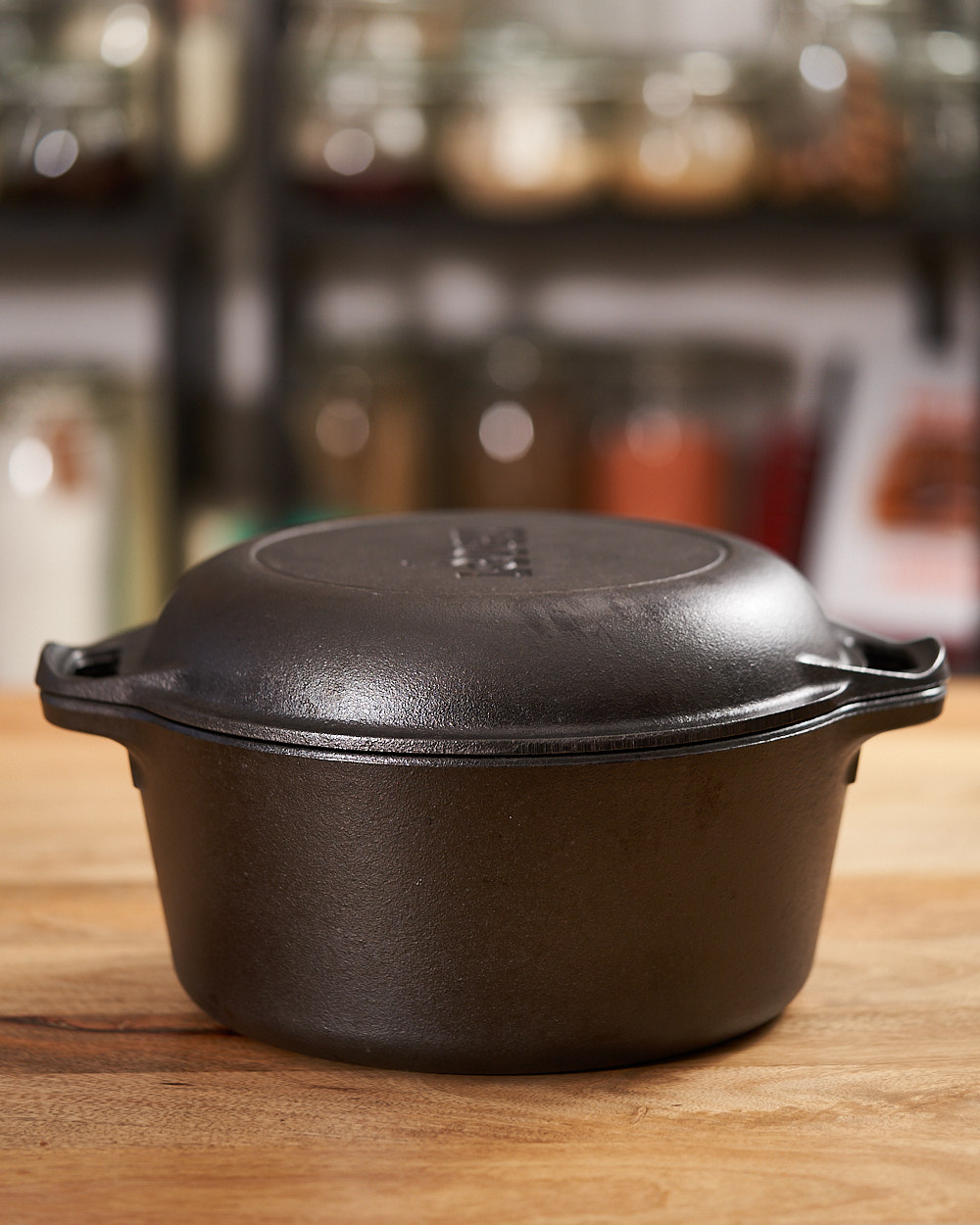
You don’t need a Dutch Oven to bake bread, but if you want one anyway, Lodge’s 5 Quart, Cast Iron, 2-in-1 Casserole Pot (affiliate link) is a good choice. I’m not going to cover cooking with cast iron as I mostly use this Dutch oven to bake bread.
Pros
Retains heat well
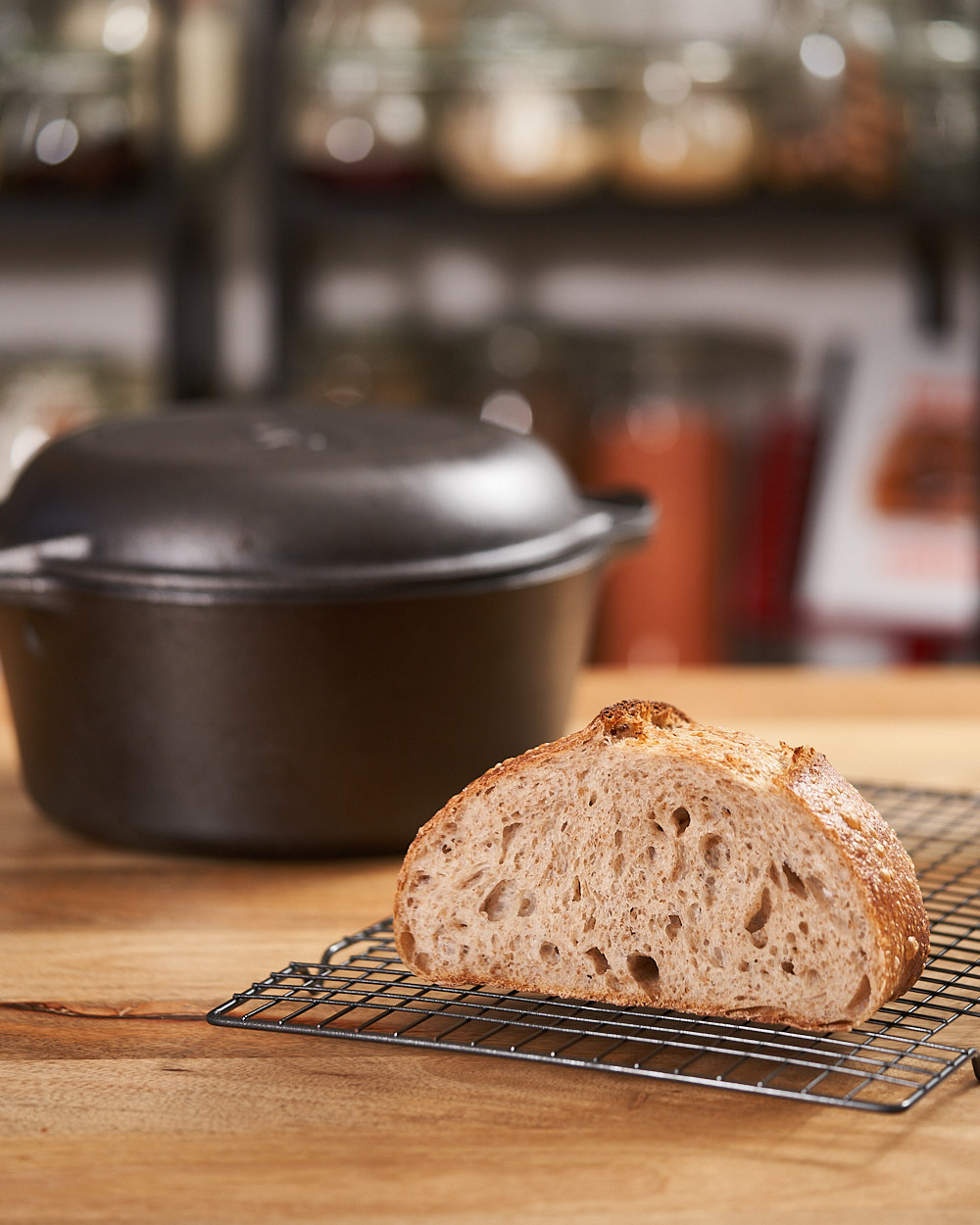
I’d previously baked my sourdough loaves in a stainless steel pan but it wasn’t a great conductor of heat. Switching to cast iron was like night and day. My loaves baked considerably faster and my crust was more golden and chewy.
Generous size
The Lodge 5 quart pot is one of the bigger models. There’s a popular 3.2 quart combo cooker; it’s not as deep and has a longer handle on one side. I opted for the 5 quart because a Redditor mentioned that their 500g loaves would sometimes hit the top of the 3 quart pot. I didn’t want an unintentional onion loaf. My 400g loaves sometimes take up the entire width of the pot, but most people bake 500g loaves with no issue.
I read a few reviews where people said you could only bake round loaves in this Dutch oven but that hasn't been my experience. You can’t bake baguettes in it but you can definitely bake batards.
Invertible
Both the lid and the pot can be used as the base. It’s much easier to put your dough into the shallow lid, rather than the deep pot. The 3.2 quart version can be used upside down as well. There’s another Lodge 5 quart pot with a more traditional lid that has a handle on top, but it can’t be inverted. If I owned that pot I’d invest in a dough sling.
Multi-purpose
There’s a well-known rule that says to avoid single purpose kitchen items, and I did believe it, until I bought a cherry pitter. I’ve cooked with the Lodge pot several times (salmon, tofu and courgettes). The food gets a lovely char but the clean up was an effort so I generally stick to my carbon steel pans.
Overall, it’s low maintenance. For baking bread, the main pot tends to stays clean. The lid gets floury and picks up residue from our hard Norfolk water, but a quick wash and oil makes the pan look brand new again.
Reasonable price
Lodge is often seen as a budget-friendly brand but we pay through the nose here in the UK. I watched the price fluctuate for weeks, then pounced when it dropped to £68. Currently the 5 quart pot is £116 ($158) on Amazon in the UK and $60 in the US (affiliate links). If you're in the UK, it's cheaper to buy from Amazon US using AmazonGlobal shipping: £62.53 (£43.77 plus £18.76 shipping).
At around £70, it's 77% cheaper than the alternatives I considered (covered below). If I dropped it, I’d be annoyed, and would probably have to replace some floor tiles, but I wouldn’t lose sleep over it. I couldn’t say the same for Le Creuset.
Good quality
I can’t claim that Lodge is the ultimate in cast iron. Plenty of chefs on Reddit have complained about Lodge being a rough and ready brand. The surface sometimes gets likened to sandpaper (although Lodge claims that this helps the cast iron to maintain its seasoning). It’s not really relevant for baking bread. When I’ve cooked with it, often using the Derek Sarno method, the food releases easily.
Something to look out for: the pans are seasoned with oil on a hanging conveyor, so the pots may come with a mark that looks like rust. It’s where they’ve been hanging and is oil that isn’t fully carbonised. The mark might eventually chip away, leaving a brown colour. It should disappear as you use the pan. Mine only had a tiny spot. A lot of reviews mention Lodge's poor quality control, and if you’ve got any chips or cracks, of course you’ll want a replacement. But I wonder if people have sometimes mistaken the seasoning spot for a defect.
No enamel
I’m not against enamel but I’ve read that if you repeatedly heat an empty enamel Dutch oven, the sudden change in temperature can cause crazing (fine, web-like cracks). As long as the enamel isn’t flaking off, the pot should still be safe to use. On the other hand, loads of people have baked bread in their enamel Dutch ovens for years, and have had no problems. But I like that it’s not a consideration here. No enamel means no chance of crazing or discolouring.
Cons
Weight
This Dutch oven weighs 5.6 kilos (12.37 lbs). I don’t struggle with the weight but it comes up a lot in reviews. It feels wrong to list it as a con because although a thinner pot would be lighter, it wouldn’t function as well. It’ll come down to personal preference, but be mindful of the weight, especially if you have strength or mobility issues with your wrists or hands.
Small handles
It’s difficult to get your fingers into the handles, with or without gloves. The pot and lid sit perfectly flush so it's tricky to remove one from the other. Offsetting the handles allows the lid to lift straight off. I found that my regular fabric oven mitts don’t work well with this Dutch oven. Chunky gloves give you no dexterity with a hot, heavy pot.
Lots of people recommended welding gloves, but I ended up buying silicone (affiliate link). I still feel some heat through them, but they have individual, non-slip fingers so I feel much safer handling the Dutch oven now.
Storage
This is a large Dutch oven so storage may be an issue. Mine lives on an open shelf and although I complained that the handles are small, they do make the pot easier to store. The 3 quart pot has one handle that sticks out a bit more; overall, I prefer the smaller, symmetrical handles.
It’s worth measuring your oven to check that the Dutch oven will fit. I’ve got a double oven and for years I just used the top one, because the bottom one had broken. I don’t have that oven any more but I’m positive that the 5 quart pot wouldn’t have fitted in it.
Alternatives
Le Creuset
I’m a Le Creuset fan but a 24cm casserole dish is currently £319. I can’t justify that for bread.
I used my neighbour’s Le Creuset years ago, and it was lovely, but I know that she makes other foods in it besides bread. I use my Instant Pot for anything that’s stew or casserole-like so that would make the Le Creuset pot a single-purpose item for me.
When I bake bread, I put the Dutch oven into my oven empty, and heat it to 240°C or 465°F, for 30 minutes. I would be really upset if I spent £300 on a Dutch oven then one day the enamel crazed.
Le Creuset is considerably cheaper on Amazon (around £100 less), but some of the reviews wondered if they’re factory seconds, citing pin holes in the enamel. I don’t know if that’s true, but I wouldn’t want to spend over £200 on something that’s flawed. Plus, if I dropped it, I would be heart-broken. It’s too expensive to warrant an immediate replacement.
The Challenger
The Challenger is custom-built for baking bread and it’s beautifully designed. The handles are brilliant. When I first used my Lodge Dutch oven, with my sock puppet gloves, I struggled because I wasn’t used to its size. As I wrangled it, I thought: “hmm, those Challenger handles would be nice right about now”.
The Challenger is roomy too - you can fit two loaves or baguettes side by side. So why didn’t I go for it? Partly because it’s a single-purpose item and similarly priced to Le Creuset. But mainly because I would’ve felt pressure to bake perfectly shaped, airy, big-eared loaves. I thought: what if I spent all that money on The Challenger and my loaves were rubbish? I’d be so disappointed.
The sourdough loaves I’m baking at the moment are, by my standard, pretty decent. Especially as I’m sort of cheating by using a bread maker. There’s plenty of room for improvement with the shape and crumb though.
If I baked more, I would probably treat myself to The Challenger, but I bake one loaf a week. Lodge is perfect for that. And if I stopped baking sourdough for a while, at least I could still use the Dutch oven for other things, whereas the Challenger would sit on my shelf, sad and taking up precious shelf space.
Whenever I buy something for my kitchen, I usually go for the more expensive option, with longevity in mind. On this occasion, the Lodge Dutch oven happened to be the cheapest and I’ve been delighted with it. If I dropped it I would replace it immediately.
